
Types of Solutions Based on States of Solute & Solvent

In chemistry, solutions are homogeneous mixtures composed of two or more substances. A fundamental classification is based on the physical states (solid, liquid, or gas) of the solute and solvent. Understanding the types of solutions based on states of solute and solvent is crucial for competitive exams like SSC, RRB, UPSC, CDS, and various State

Types of Solutions Based on States of Solute & Solvent Read More »
Goiter – Causes, Types, Symptoms & Exam Facts | SSC, UPSC, RRB Notes

Goiter is a medical condition characterized by the abnormal enlargement of the thyroid gland, located at the base of the neck. It may result from various factors including iodine deficiency, hormonal imbalances, or autoimmune diseases. This topic is frequently asked in exams like SSC CGL, UPSC Prelims, RRB NTPC, CDS, and State PSCs, especially in

Goiter – Causes, Types, Symptoms & Exam Facts | SSC, UPSC, RRB Notes Read More »

Blood Coagulation – Explained Simply for Competitive Exams

“Your blood is smarter than you think! It knows exactly when to flow and when to stop.” When you get a cut or injury, your blood doesn’t keep flowing forever — it stops automatically after some time. Why? Because of a life-saving process called blood coagulation or blood clotting. Let’s understand this amazing natural mechanism

Blood Coagulation – Explained Simply for Competitive Exams Read More »

Guard Cells: The Tiny Gatekeepers of Plants

Have you ever wondered how plants breathe? Just like humans have lungs, plants have tiny openings called stomata that help them exchange gases. But who controls these stomata? That’s where guard cells come into play! These tiny cells act like security guards, opening and closing the stomata to help plants survive. Let’s dive deeper into

Guard Cells: The Tiny Gatekeepers of Plants Read More »

Khadar Soil: Overview, Characteristics, and Importance

Soil plays a crucial role in agriculture, the environment, and geography. One of the most fertile soils in India is Khadar Soil. In this blog, we will explore what Khadar is, its characteristics, significance, and comparison with other types of alluvial soil. This guide is tailored to help students preparing for SSC, RRB NTPC, UPSC,

Khadar Soil: Overview, Characteristics, and Importance Read More »

Exploring the Different Types of Systems in Chemistry: Open, Closed & Isolated

In Chemistry, the term system refers to a specific part of the universe that is under observation or study. Everything outside this system is called the surroundings. The interaction between the system and its surroundings helps us understand various chemical and physical processes. In this article, we will explore the different types of systems in

Exploring the Different Types of Systems in Chemistry: Open, Closed & Isolated Read More »

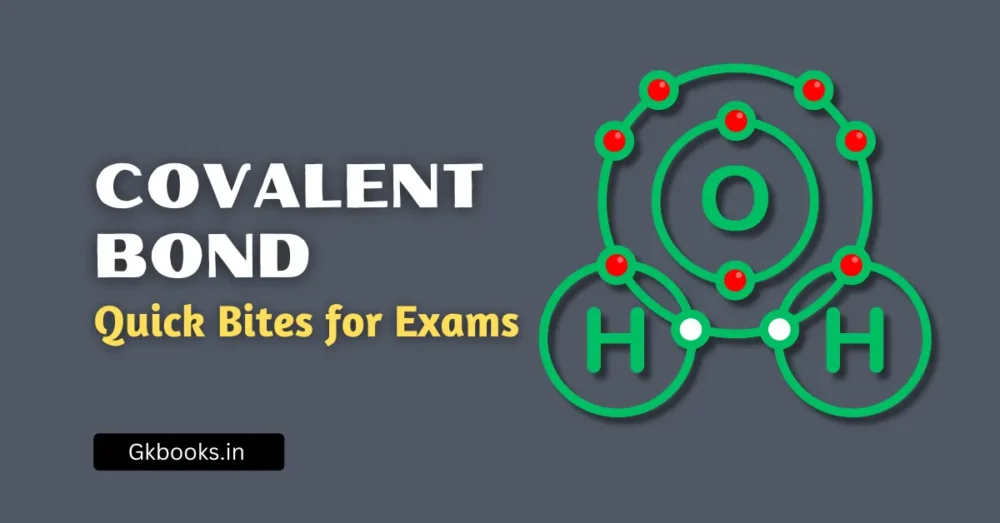
Covalent Bond: Compact Notes for Quick Review

Covalent Bond: Compact Notes for Quick Review

A covalent bond is a chemical bond formed when two or more atoms share electrons to create stable electron pairs, typically between non-metal atoms, to achieve a full outer electron shell. In the world of chemistry, atoms combine to form different substances. They do this by forming chemical bonds. One important type of chemical bond is

Covalent Bond: Compact Notes for Quick Review Read More »

Rhodophyceae – The Red Algae: Based on NCERT

Rhodophyceae, commonly known as red algae, is a group of algae that mainly live in marine environments. They are unique due to the predominance of the red pigment, R-phycoerythrin, in their body. These algae play a significant role in marine ecosystems and have various uses in food, industry, and medicine. What is Rhodophyceae? Characteristics of

Rhodophyceae – The Red Algae: Based on NCERT Read More »

Phaeophyceae (Brown Algae) – A Complete Guide

Have you ever wondered why some seaweeds appear brown? These belong to a special group of algae called Phaeophyceae, commonly known as brown algae. In this blog post, we will explore everything about Phaeophyceae in a simple and easy-to-understand way. Whether you’re preparing for SSC, RRB NTPC, UPSC, or state-level exams, this topic is important

Phaeophyceae (Brown Algae) – A Complete Guide Read More »

Algae Classification Notes: A Simple Guide for Competitive Exams

Algae are simple, plant-like organisms that play an important role in nature. They are autotrophic (make their own food using sunlight) and can be found in water bodies, moist places, and even snow-covered mountains. Understanding algae classification is important for competitive exams like SSC, RRB NTPC, UPSC, and state-level exams. Let’s explore this topic in

Algae Classification Notes: A Simple Guide for Competitive Exams Read More »

Chlorophyceae (Green Algae) – A Complete Guide

The world of plants and algae is vast and diverse. Among them, Chlorophyceae, commonly known as Green Algae, is one of the most important groups. These algae play a crucial role in nature and have various applications in human life. In this blog post, we will explore the features, classification, examples, and significance of Green

Chlorophyceae (Green Algae) – A Complete Guide Read More »

Formed Elements in Blood: Explained for Competitive Exams

Blood is a vital fluid in our body that transports oxygen, nutrients, and waste materials. It consists of two main components: In this post, we will focus on the formed elements in blood, which include red blood cells (RBCs), white blood cells (WBCs), and platelets. Understanding these components is essential for various competitive exams like

Formed Elements in Blood: Explained for Competitive Exams Read More »

An Overview of the Cell: NCERT Cell the Unit of Life

The cell is the basic unit of life. All living organisms, from the tiniest bacteria to the largest animals, are made up of cells. Some organisms, like bacteria, have only one cell (unicellular), while others, like humans, have trillions of cells (multicellular). In this post, we will explore the structure, types, and functions of cells

An Overview of the Cell: NCERT Cell the Unit of Life Read More »

Endoplasmic Reticulum: The Cell’s Transport System

The Endoplasmic Reticulum (ER) is one of the most important organelles inside a cell. It acts as a transport system, helping in the movement of materials inside the cell. Let’s explore its structure, types, and functions in simple terms. What is the Endoplasmic Reticulum? The Endoplasmic Reticulum (ER) is a network of tiny tubular structures

Endoplasmic Reticulum: The Cell’s Transport System Read More »

Vacuoles: Structure, Functions, and Importance

Vacuoles are an essential part of a cell. They help store materials, maintain the cell’s shape, and perform other important functions. In this article, we will explore what vacuoles are and their structure, types, and functions in simple terms. This knowledge is useful for students preparing for SSC, RRB NTPC, UPSC, and state-level exams. What

Vacuoles: Structure, Functions, and Importance Read More »

Ads Blocker Image Powered by Code Help Pro

Ads Blocker Detected!!!

We have detected that you are using extensions to block ads. Please support us by disabling these ads blocker.

Powered By
100% Free SEO Tools - Tool Kits PRO
Scroll to Top