Chemistry Notes

Welcome to your ultimate resource for mastering Chemistry. Browse our extensive collection of Chemistry Notes tailored for students preparing for Board Exams (Class 11 & 12) and a wide range of competitive tests. Whether you are targeting NEET and JEE, or the General Science sections of SSC, UPSC, CDS, and State Level Exams, our study materials simplify complex concepts into easy-to-understand summaries.

👉 Explore the Complete Chemistry Notes: Topic-Wise List for NEET, JEE, SSC & UPSC

Properties of Acids – Explained with Examples

Properties of Acids – Explained with Examples

Acids are one of the most important chemical substances in our daily life and industrial processes. From the sour taste of lemon to the acidic nature of gastric juices, acids play a crucial role in both biological and chemical systems. Understanding their properties is essential for competitive exams like SSC, UPSC, RRB, and various state […]

Properties of Acids – Explained with Examples Read More »

Analgesics Types, Uses, and Mechanism Explained

Analgesics – Types, Uses, and Mechanism Explained

Analgesics are one of the most commonly used medicines in everyday life, making them an essential topic in General Science for UPSC, SSC CGL, CHSL, RRB NTPC, State PSCs, and other competitive exams. Whether it’s a headache or a post-surgery pain, analgesics provide pain relief. This blog will help you understand the topic in a

Analgesics – Types, Uses, and Mechanism Explained Read More »

Antacids: Definition, Mechanism, and Modern Treatment for Acidity – Complete Notes for Exams

Antacids: Definition, Mechanism, and Modern Treatment for Acidity – Complete Notes for Exams

Antacids are a crucial topic under “Chemistry in Everyday Life” and “Acids, Bases, and Salts”, often asked in UPSC, SSC, RRB NTPC, and State PSCs. Beyond their use in daily life, understanding how antacids work, and what led to better alternatives, helps answer MCQs, match-the-following, and conceptual questions in exams. Let’s understand everything about antacids

Antacids: Definition, Mechanism, and Modern Treatment for Acidity – Complete Notes for Exams Read More »

Allotropes of Oxygen – Explained Simply for Exam Aspirants!

Allotropes of Oxygen – Explained Simply for Exam Aspirants!

If you are preparing for SSC, RRB NTPC, UPSC, or State PSC exams, you must understand some basic science topics — and “Allotropes of Oxygen” is one of them. But don’t worry! We’ll break it down into simple parts. Let’s dive in! 🧠📘 What are Allotropes? ◾ Allotropes are different forms of the same element.🔹

Allotropes of Oxygen – Explained Simply for Exam Aspirants! Read More »

Colloidal Solution – A Simple Guide for Competitive Exams

Colloidal Solution – A Simple Guide for Competitive Exams

Are you confused between solutions, suspensions, and colloids? Don’t worry! Today, we’ll make the Colloidal Solution crystal clear and easy to understand—even if you’re just starting your preparation. Let’s get started! 💪 What is a Colloidal Solution? A colloidal solution is a mixture in which tiny particles of one substance are spread evenly throughout another

Colloidal Solution – A Simple Guide for Competitive Exams Read More »

Valence Electrons Definition, Examples, and Importance for Exams

Valence Electrons: Definition, Examples, and Importance for Exams

Valence electrons are the building blocks of chemical bonding and reactivity—a core concept in chemistry that appears frequently in NCERT textbooks (Class 9–12) and competitive exams like UPSC, SSC, RRB NTPC, and State PSCs. Understanding valence electrons helps explain: This makes it a must-know topic for all science learners and exam aspirants. What are Valence

Valence Electrons: Definition, Examples, and Importance for Exams Read More »

Alkali Metals – Explained Simply

Alkali metals are a group of soft and shiny metals that are very important in science. They are found in the first column of the periodic table. These metals include lithium, sodium, potassium, rubidium, cesium, and francium. They are called “alkali” because they form strong bases (alkalies) when mixed with water. These metals react quickly

Alkali Metals – Explained Simply Read More »

Alkaline Earth Metals: A Simplified Notes

Alkaline Earth Metals are an important group of elements in the periodic table that you will encounter in various competitive exams like SSC, RRB NTPC, UPSC, and state-level exams. These elements play a crucial role in many chemical processes and have unique properties that make them easy to identify. In this post, we’ll break down

Alkaline Earth Metals: A Simplified Notes Read More »

Atomic Mass Number Notes with Top MCQs

Are you preparing for competitive exams like SSC, Banking, RRB NTPC, UPSC, or any State-level exam? Then learning about the Atomic Mass Number is super important! This topic comes under General Science Chemistry, and it’s one of the most common questions in exams. In this blog, you’ll find simple notes on Atomic Mass Number explained

Atomic Mass Number Notes with Top MCQs Read More »

Types of Solutions Based on States of Solute & Solvent

In chemistry, solutions are homogeneous mixtures composed of two or more substances. A fundamental classification is based on the physical states (solid, liquid, or gas) of the solute and solvent. Understanding the types of solutions based on states of solute and solvent is crucial for competitive exams like SSC, RRB, UPSC, CDS, and various State

Types of Solutions Based on States of Solute & Solvent Read More »

Exploring the Different Types of Systems in Chemistry: Open, Closed & Isolated

In Chemistry, the term system refers to a specific part of the universe that is under observation or study. Everything outside this system is called the surroundings. The interaction between the system and its surroundings helps us understand various chemical and physical processes. In this article, we will explore the different types of systems in

Exploring the Different Types of Systems in Chemistry: Open, Closed & Isolated Read More »

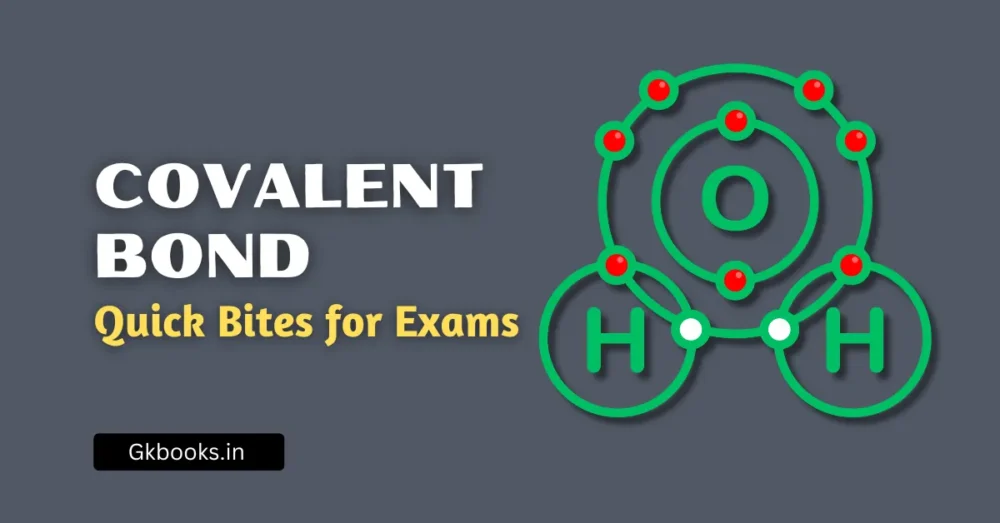
Covalent Bond: Compact Notes for Quick Review

Covalent Bond: Compact Notes for Quick Review

A covalent bond is a chemical bond formed when two or more atoms share electrons to create stable electron pairs, typically between non-metal atoms, to achieve a full outer electron shell. In the world of chemistry, atoms combine to form different substances. They do this by forming chemical bonds. One important type of chemical bond is

Covalent Bond: Compact Notes for Quick Review Read More »

Radioactivity: A Simple Guide for Competitive Exam Aspirants

Radioactivity is a fascinating topic in science that helps us understand the behavior of atoms. It plays a crucial role in various fields, including medicine, energy production, and space exploration. In this article, we will break down radioactivity into simple, easy-to-understand sections, perfect for students preparing for SSC, RRB NTPC, UPSC, and state-level exams. What

Radioactivity: A Simple Guide for Competitive Exam Aspirants Read More »

Atomic Number: A Fundamental Concept in Chemistry

Understanding the atomic number is essential for mastering chemistry. It plays a key role in identifying elements and helps in organizing the periodic table. In this blog post, we will explore the meaning, significance, and application of atomic numbers in a simple and engaging way. What is an Atomic Number? ◾Atomic Number – Know Atomic

Atomic Number: A Fundamental Concept in Chemistry Read More »

Types of Bonds in Chemistry: Detailed Notes

Chemistry is all about how different elements interact with each other to form various substances. These interactions happen due to chemical bonds. Understanding these bonds is important for students preparing for competitive exams like SSC, RRB NTPC, UPSC, or state-level exams. In this article, we will explore the different types of chemical bonds in a

Types of Bonds in Chemistry: Detailed Notes Read More »

Hydrophobic: A Simple Explanation for Students

Have you ever seen how water forms droplets on a leaf or a waxed car? Have you noticed how oil does not mix with water? This happens because of a special property called hydrophobicity. In this article, we will learn what hydrophobic means, why some substances repel water, and how this property is useful in

Hydrophobic: A Simple Explanation for Students Read More »

Galvanisation: Understanding the Process and Its Importance

Hello, future achievers! Today, we will learn about galvanisation, a very important process used to protect metals from rusting and corrosion. Understanding this concept will help you in your exams and give you a solid foundation in science, especially when it comes to materials and their properties. Let’s break this down into simple sections to

Galvanisation: Understanding the Process and Its Importance Read More »

Combination Reactions: A Simple and Easy Explanation

In chemistry, reactions can happen in many different ways. One such type is the Combination Reaction. This is an important concept to understand, especially for competitive exams like SSC, RRB NTPC, UPSC, or state-level exams. Let’s break it down step by step to make it easier for you! What is a Combination Reaction? A combination

Combination Reactions: A Simple and Easy Explanation Read More »

Scroll to Top