General Science

“General Science” is the highest scoring as well as the most challenging section for all competitive exams. In this section, you will find important notes on three main subjects of General Science: Physics, Chemistry, Biology, etc.

You can Browse the Subject- wise General Science Notes here:

Guard Cells: The Tiny Gatekeepers of Plants

Have you ever wondered how plants breathe? Just like humans have lungs, plants have tiny openings called stomata that help them exchange gases. But who controls these stomata? That’s where guard cells come into play! These tiny cells act like security guards, opening and closing the stomata to help plants survive. Let’s dive deeper into

Guard Cells: The Tiny Gatekeepers of Plants Read More »

Exploring the Different Types of Systems in Chemistry: Open, Closed & Isolated

In Chemistry, the term system refers to a specific part of the universe that is under observation or study. Everything outside this system is called the surroundings. The interaction between the system and its surroundings helps us understand various chemical and physical processes. In this article, we will explore the different types of systems in

Exploring the Different Types of Systems in Chemistry: Open, Closed & Isolated Read More »

Covalent Bond: Compact Notes for Quick Review

Covalent Bond: Compact Notes for Quick Review

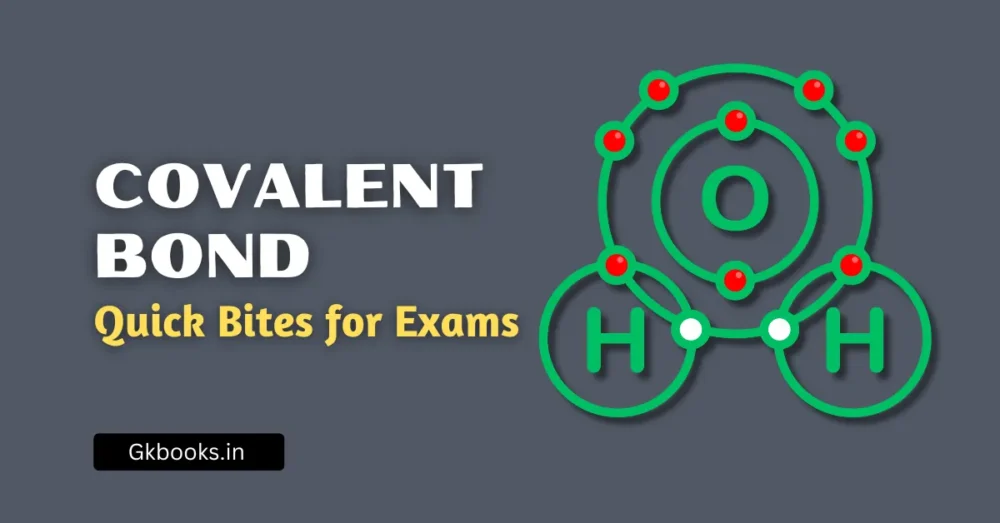
A covalent bond is a chemical bond formed when two or more atoms share electrons to create stable electron pairs, typically between non-metal atoms, to achieve a full outer electron shell. In the world of chemistry, atoms combine to form different substances. They do this by forming chemical bonds. One important type of chemical bond is

Covalent Bond: Compact Notes for Quick Review Read More »

Rhodophyceae – The Red Algae: Based on NCERT

Rhodophyceae, commonly known as red algae, is a group of algae that mainly live in marine environments. They are unique due to the predominance of the red pigment, R-phycoerythrin, in their body. These algae play a significant role in marine ecosystems and have various uses in food, industry, and medicine. What is Rhodophyceae? Characteristics of

Rhodophyceae – The Red Algae: Based on NCERT Read More »

Phaeophyceae (Brown Algae) – A Complete Guide

Have you ever wondered why some seaweeds appear brown? These belong to a special group of algae called Phaeophyceae, commonly known as brown algae. In this blog post, we will explore everything about Phaeophyceae in a simple and easy-to-understand way. Whether you’re preparing for SSC, RRB NTPC, UPSC, or state-level exams, this topic is important

Phaeophyceae (Brown Algae) – A Complete Guide Read More »

Algae Classification Notes: A Simple Guide for Competitive Exams

Algae are simple, plant-like organisms that play an important role in nature. They are autotrophic (make their own food using sunlight) and can be found in water bodies, moist places, and even snow-covered mountains. Understanding algae classification is important for competitive exams like SSC, RRB NTPC, UPSC, and state-level exams. Let’s explore this topic in

Algae Classification Notes: A Simple Guide for Competitive Exams Read More »

Chlorophyceae (Green Algae) – A Complete Guide

The world of plants and algae is vast and diverse. Among them, Chlorophyceae, commonly known as Green Algae, is one of the most important groups. These algae play a crucial role in nature and have various applications in human life. In this blog post, we will explore the features, classification, examples, and significance of Green

Chlorophyceae (Green Algae) – A Complete Guide Read More »

Formed Elements in Blood: Explained for Competitive Exams

Blood is a vital fluid in our body that transports oxygen, nutrients, and waste materials. It consists of two main components: In this post, we will focus on the formed elements in blood, which include red blood cells (RBCs), white blood cells (WBCs), and platelets. Understanding these components is essential for various competitive exams like

Formed Elements in Blood: Explained for Competitive Exams Read More »

An Overview of the Cell: NCERT Cell the Unit of Life

The cell is the basic unit of life. All living organisms, from the tiniest bacteria to the largest animals, are made up of cells. Some organisms, like bacteria, have only one cell (unicellular), while others, like humans, have trillions of cells (multicellular). In this post, we will explore the structure, types, and functions of cells

An Overview of the Cell: NCERT Cell the Unit of Life Read More »

Endoplasmic Reticulum: The Cell’s Transport System

The Endoplasmic Reticulum (ER) is one of the most important organelles inside a cell. It acts as a transport system, helping in the movement of materials inside the cell. Let’s explore its structure, types, and functions in simple terms. What is the Endoplasmic Reticulum? The Endoplasmic Reticulum (ER) is a network of tiny tubular structures

Endoplasmic Reticulum: The Cell’s Transport System Read More »

Vacuoles: Structure, Functions, and Importance

Vacuoles are an essential part of a cell. They help store materials, maintain the cell’s shape, and perform other important functions. In this article, we will explore what vacuoles are and their structure, types, and functions in simple terms. This knowledge is useful for students preparing for SSC, RRB NTPC, UPSC, and state-level exams. What

Vacuoles: Structure, Functions, and Importance Read More »

Mitochondria: The Powerhouse of the Cell

Mitochondria are one of the most important cell organelles. They are often called the “Powerhouse of the Cell” because they produce energy for the cell to function. Let’s explore their structure, function, and significance in detail. What is Mitochondria? Mitochondria (singular: mitochondrion) are tiny, rod-shaped organelles found in the cytoplasm of both plant and animal

Mitochondria: The Powerhouse of the Cell Read More »

Introduction to Ferromagnetism: A Simple Explanation

Have you ever played with a magnet and seen how it sticks to some metals but not others? This amazing property is due to ferromagnetism! It is the reason why materials like iron, cobalt, and nickel become strong magnets. Ferromagnetism is an important topic in general science Physics and is often asked about in competitive

Introduction to Ferromagnetism: A Simple Explanation Read More »

Radioactivity: A Simple Guide for Competitive Exam Aspirants

Radioactivity is a fascinating topic in science that helps us understand the behavior of atoms. It plays a crucial role in various fields, including medicine, energy production, and space exploration. In this article, we will break down radioactivity into simple, easy-to-understand sections, perfect for students preparing for SSC, RRB NTPC, UPSC, and state-level exams. What

Radioactivity: A Simple Guide for Competitive Exam Aspirants Read More »

Speed of Light: In-Depth Notes for Competitive Exams

The speed of light is one of the most fundamental concepts in physics. From the Sun’s rays that brighten our world to the glow of a firefly at night, light is everywhere. Understanding it is crucial for competitive exams like SSC, RRB NTPC, UPSC, and state-level exams. This guide simplifies the concept of the speed

Speed of Light: In-Depth Notes for Competitive Exams Read More »

Ads Blocker Image Powered by Code Help Pro

Ads Blocker Detected!!!

We have detected that you are using extensions to block ads. Please support us by disabling these ads blocker.

Powered By
100% Free SEO Tools - Tool Kits PRO
Scroll to Top