If you are preparing for the WBCS Agriculture Optional or studying for your B.Sc. in Agriculture, you know that one variable dictates the success of Indian agriculture more than any other: The Atmosphere.
While soil can be amended and varieties can be improved, weather remains the most unpredictable and influential factor in crop production. In India, where nearly 51% of the net sown area is rainfed, understanding the nuances of agro-meteorology is not just academic—it’s survival.
In this guide, we will break down the specific roles of climatic factors—solar radiation, temperature, rainfall, and humidity—and how they dictate crop yield in the Indian context.
💡 Quick Answer
How do climate and weather affect crop production?
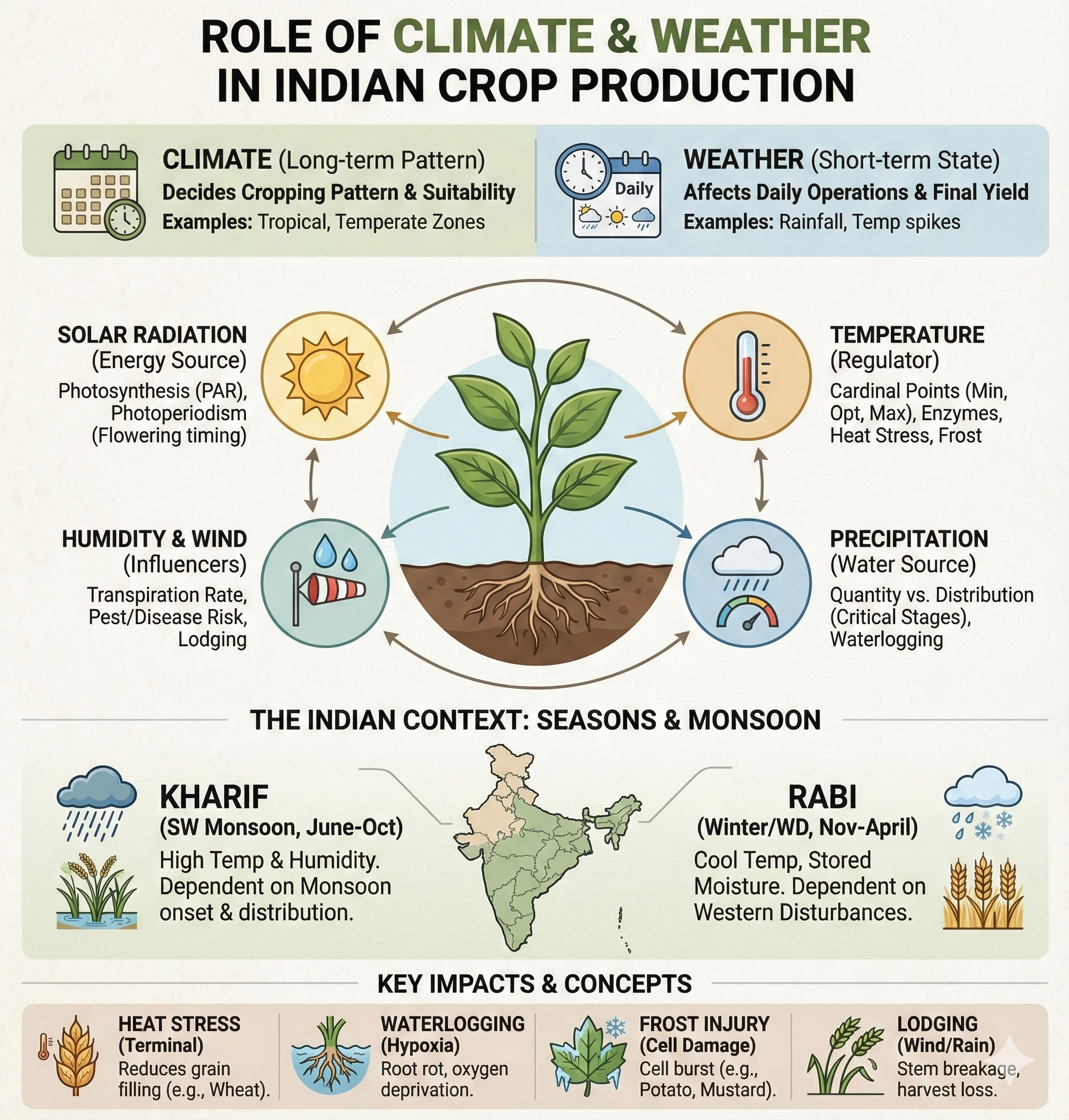
Climate determines what can be grown in a region (suitability), while weather determines how much will be produced in a specific season (yield). Factors like solar radiation drive photosynthesis; temperature regulates enzymatic activity and germination; rainfall meets water requirements; and relative humidity influences pest and disease incidence. In India, the South-West Monsoon is the single most critical weather event for Kharif crops.
1. Weather vs. Climate: The Fundamental Difference
| Feature | Weather | Climate |
| Definition | The physical state of the atmosphere at a specific time and place. | The long-term average weather pattern of a region. |
| Time Scale | Short-term (Hours, Days). | Long-term (More than 30 years). |
| Variability | Highly variable and dynamic. | Relatively stable and predictable. |
| Agricultural Impact | Influences daily operations (sowing, spraying, harvesting). | Decides the Cropping Pattern and selection of crops for a region. |
| Example | “It rained heavily in Burdwan yesterday.” | “West Bengal has a Tropical Wet-and-Dry Climate.” |
2. Key Climatic Elements Influencing Crop Production
A. Solar Radiation (The Energy Source)
Solar radiation is the primary source of energy for the biosphere. Its influence is threefold:
- Intensity: High intensity favors photosynthesis (measured as PAR – Photosynthetically Active Radiation). However, too high intensity can cause photo-oxidation.
- Quality: Red and Blue light are most effective for photosynthesis.
- Duration (Photoperiodism): This is critical for flowering.
- Short Day Plants: Rice, Soybean (Flower when day length is < critical length).
- Long Day Plants: Wheat, Barley (Flower when day length is > critical length).
- Day Neutral Plants: Tomato, Maize, Sunflower (Flowering is independent of day length).
B. Temperature (The Regulator)
Temperature regulates the rate of biochemical reactions. Every crop has three Cardinal Temperatures:
- Minimum: Below which growth stops.
- Optimum: At which growth is maximum.
- Maximum: Above which growth stops or plants die.
Specific Effects:
- Vernalization: Some crops like winter wheat require a “chilling treatment” (low temperature) to initiate flowering.
- Thermoperiodism: Plants respond to the difference between day and night temperatures. Cool nights favor yield in potatoes by reducing respiration losses.
- Heat Stress: In India, “Terminal Heat Stress” (sudden high temp in Feb/March) causes shriveling of Wheat grains, drastically reducing yield.
C. Precipitation (The Water Source)
In India, rainfall is the most limiting factor.
- Quantity: Crops like Rice and Sugarcane need heavy rainfall (>1500mm), while Millets and Sorghum thrive in low rainfall (<500mm).
- Distribution: Total rainfall matters less than distribution. A dry spell during the Critical Growth Stages (like flowering or grain filling) leads to massive yield loss.
- Excess Rain: Causes waterlogging, which cuts off oxygen to roots (hypoxia), leading to root rot.
D. Atmospheric Humidity
- Transpiration: High humidity reduces the transpiration rate, slowing down nutrient uptake from the soil.
- Pest & Disease: High humidity (>90%) combined with warm temperature is a breeding ground for fungal diseases like Rice Blast or Potato Late Blight.
E. Wind
- Beneficial: Helps in pollination (anemophily) for crops like Maize.
- Harmful: High velocity causes Lodging (bending/breaking of stems) in Sugarcane and Wheat. It also increases evapotranspiration, drying out the soil faster.
3. The Indian Context: Monsoon and Seasons
- Kharif Season (June-Oct): Coincides with the South-West Monsoon.
- Crops: Rice, Maize, Cotton.
- Weather dependence: Totally dependent on the onset and distribution of monsoon rains. High temperature and high humidity.
- Rabi Season (Nov-April): Dependent on stored soil moisture and the Western Disturbances (winter rain).
- Crops: Wheat, Mustard, Gram.
- Weather dependence: Needs cool temperatures for vegetative growth and warm temperatures for maturity.
📝Exam Corner: Key Facts for Exams
Pro-Tip: When answering subjective questions, always draw a correlation between a specific weather event and a crop stage.
- Example: “High humidity during the grain-filling stage of Rice promotes False Smut disease.”
- Albedo: The reflection coefficient of a surface. Fresh snow has the highest albedo; dark soil has low albedo.
- GDD (Growing Degree Days): A heat index used to predict when a crop will reach maturity.
- PET (Potential Evapotranspiration): The water loss from a crop field if water supply were unlimited.
🙋 Frequently Asked Questions (AEO Section)
Q: What is the most critical weather factor for Indian Agriculture?
A: The South-West Monsoon rainfall. Since it accounts for 75% of India’s annual rainfall, its timing and quantity dictate the national food security.
Q: How does high temperature affect Wheat production in India?
A: Wheat is a temperate crop. High temperatures during the grain-filling stage (Feb/March) increase the respiration rate and force early maturity, resulting in shriveled grains and reduced yield.
Q: What is the difference between photoperiodism and vernalization?
A: Photoperiodism is the plant’s response to the length of the day (light duration) for flowering, while Vernalization is the requirement of low temperature treatment to induce flowering.
Q: Why is frost dangerous for crops?
A: Frost causes the water inside plant cells to freeze and expand. This bursts the cell walls, leading to cell death. Crops like Potato and Mustard are highly susceptible to frost.
Read More on Agriculture
WBCS Agriculture Optional Syllabus (Paper I & II) – Topic-wise Breakdown
Major Agricultural Revolutions in India from 1960-2024 with MCQs
